Corrosion-free bearing blocks for lead screwsdryspin® laser sintering bearing blocks
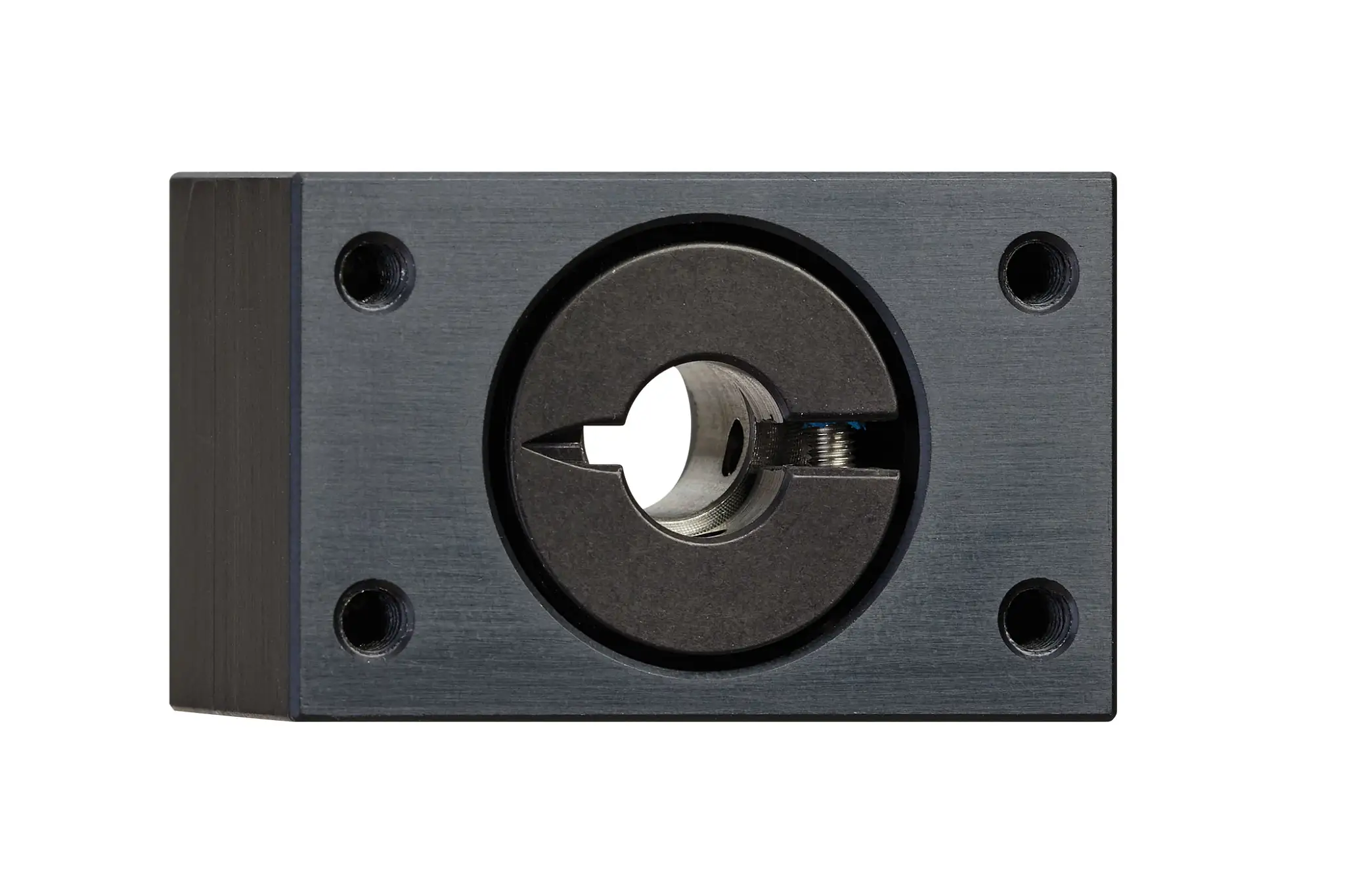
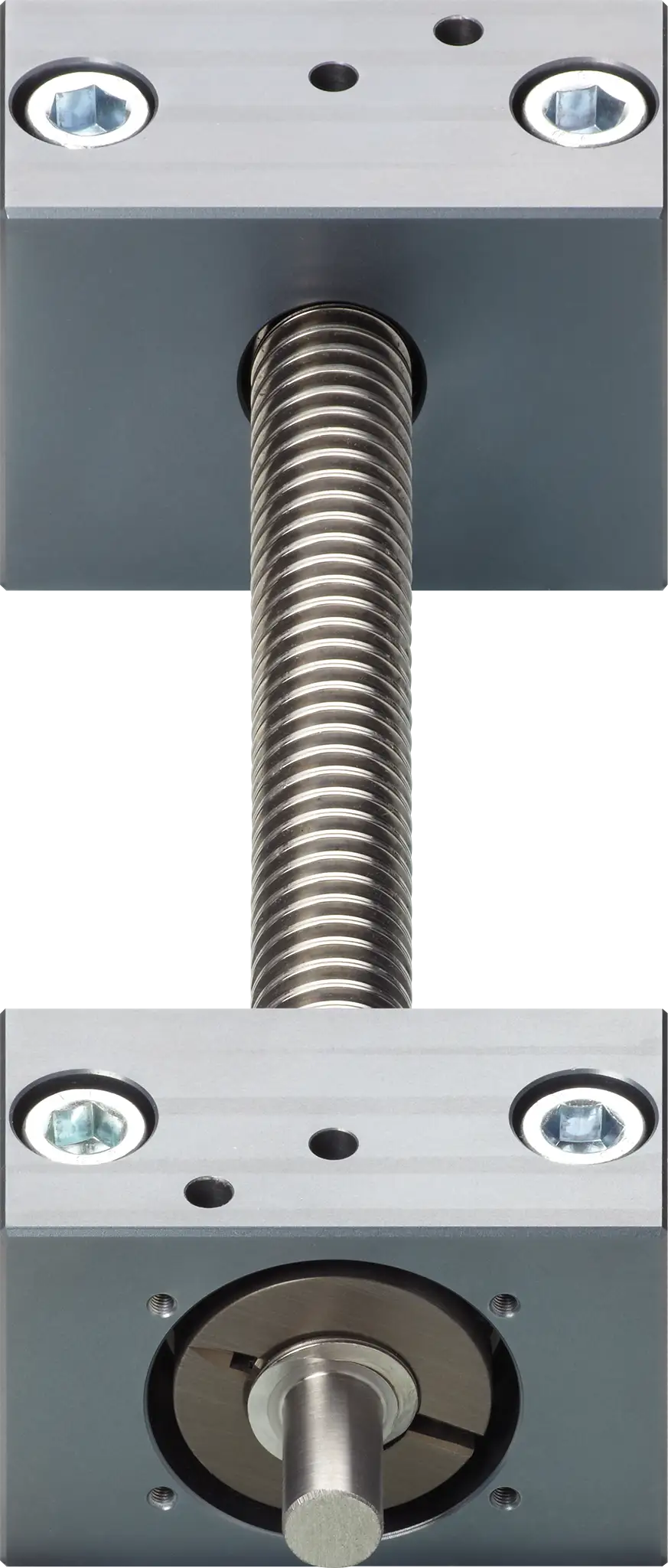
The drylin® SLS lead screw support with xiros® polymer ball bearings is designed for highly dynamic applications, such as motor-driven lead screw drives. The ball bearings reduce friction for smoother rotation at higher speeds, and like the plain bearing versions, they run without any external lubrication.
- Mounting holes for easy installation, prepared for accessories such as position indicators and manual clamps
- Recommended for motor-driven and high-speed lead screw drives
- Hard-anodized aluminum housing with dry-running xiros® polymer ball bearings
For manually operated or lower-speed drives, plain bearing versions are available as a fixed-bearing support, a floating-bearing support, and a fixed-bearing support with left-hand thread.
_________________________________________________________________________________________
Why are there different versions?
The bearing arrangement has to fulfil the principle of clarity. Furthermore, the bearing must ensure the defined control of the force flow. If it does, the bearing is considered statically determined. There are various bearing options, such as the
fixed floating bearing and the
double-sided floating bearing.
Fixed floating bearing:the fixed bearing clearly positions the shaft in an axial direction. The fixed bearing must therefore absorb both radial and axial forces and guide them into the surrounding structure. This can basically be fulfilled by a single bearing. The floating bearing corrects parallelism errors minimally and offers thermal expansion capability, which means that the cable is not stressed.
Advantages of fixed floating bearing
► No axial clearance
► Non-critical shaft expansion (due to such factors as temperature)
► Suitable for changing axial loads
► Clarity of forces applied
Double-sided floating bearing:in a double-sided floating bearing, the lead screw is not clearly fixed in the axial direction. This means that without stressing the bearing, mechanical or thermal differences in length can be absorbed, but the lead screw is not protected against drifting. This has to be considered in particular when dealing with positioning applications.
Advantages of double-sided floating bearings:
► Cost-effective
► Low design cost
► Non-critical shaft expansion (due to such factors such factors as temperature) in the area of clearance
Disadvantages:
► Not clearly fixed in the axial direction
► Not suited to changing axial loads
► Only if axial clearance does not impair function
_________________________________________________________________________________________
Versions
Fixed bearing version (FL)Depending on thread dimensions, this version has the clamping ring clamped into the lead screw itself or to the lead screw's outer diameter. For high helix lead screws, it is always the outer diameter that it is clamped to.
► Note:
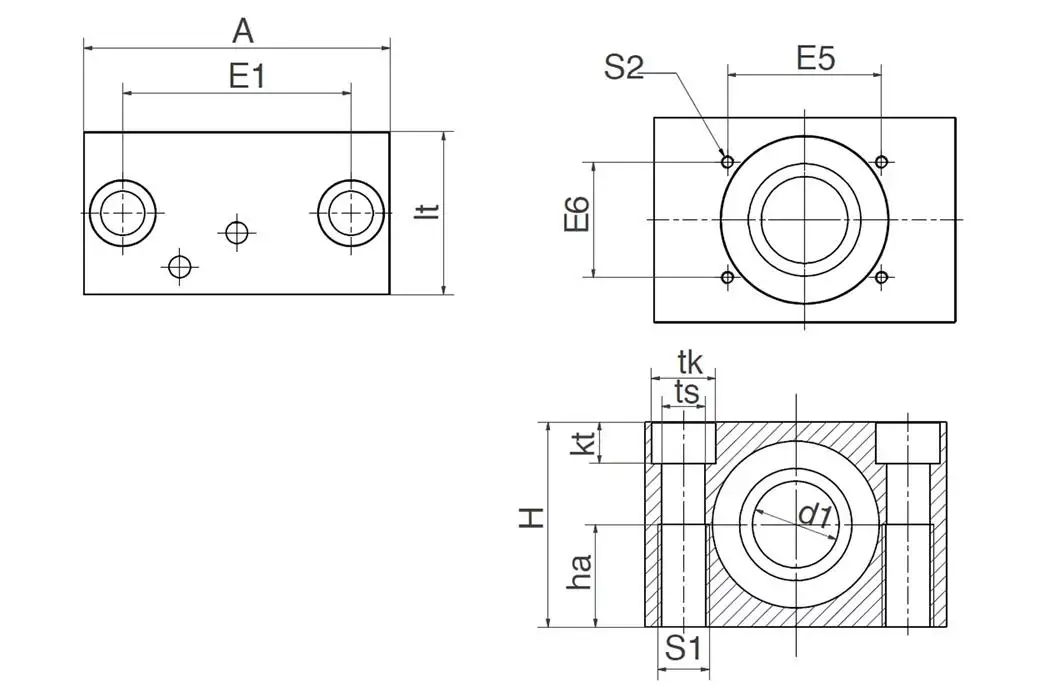
you can also choose a bearing block for your application that uses the measurement d1 for clamping onto the turned machined end.
Floating bearing (FL):depending on the lead screw's dimensions, a machined end must be turned to the value d1. You can see below which dimensions this applies to. The floating bearing block merely supports the lead screw. This type does not prevent the lead screw from drifting.
Ball bearing type (BB):this bearing block should always be used in case of highly dynamic applications, e.g. when a motor is involved
_________________________________________________________________________________________
Design tip for lead screw end machining: | Part number | d1 mm | | | | | | | | | | | | | | |
| SLS-16-LL | 12 |
| SLS-16-LL | 12 |
| SLS-18-LL | 12 |
| SLS-18-LL | 12 |
| SLS-18-LL | 12 |
| SLS-18-LL | 12 |
| SLS-20-LL | 12 |
| SLS-24-LL | 14 |
| SLS-S16-LL | 12 |
| SLS-S18-LL | 12 |
| SLS-S20-LL | 12 |
► Note on maximum load capacity: it can exceed the lead screw nut's maximum load.