Change Language :
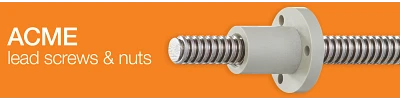
ACME Lead Screws & Nuts
Now Manufacturing ACME Lead Screws In-House for Faster Lead Times
igus now manufactures ACME lead screws in-house at our facility in East Providence, Rhode Island, making us your one-stop shop for all lead screw types, including ACME, trapezoidal, and metric threads, as well as a proprietary high helix design known as dryspin®.
As part of this expansion, our ACME lead screw production is now live with 22 available sizes, more than doubling our previous selection. We’ve also expanded our ability to configure systems using imperial measurements alongside our existing metric options, making it easier to find the right lead screw solution for a wider range of applications.
ACME lead screws are threaded rods with a trapezoidal profile featuring a wide, flat crest and steep pitch, giving them high load capacity and efficient power transmission. Compared to square-thread screws, they offer greater load-bearing strength, reduced friction, and better self-locking, making them ideal for heavy-duty, high-load systems. Trapezoidal lead screws are very similar but use a 30° flank angle instead of ACME’s 29°, and can often be used interchangeably depending on the application.
Browse ACME Screws & Nuts


Tools & Configurators
Igus offers a range of online tools to help users find the right lead screw system for their application requirements. The various tools available report suitable products based on application parameters and provide service life estimates of the chosen products. Both 2D and 3D CAD models can also be used. Systems can also be individually configured, simplifying the design process. Final configurations can be saved or sent directly to the shopping cart.


FAQ: Frequently Asked Questions
A: An ACME lead screw is a lead screw designed around imperial dimensions that is commonly used to convert the rotary motion of a motor, or hand wheel, into linear motion. They are typically used to drive linear bearings.
A: igus offers single-start ACME screws. This means there is one continuous thread that runs the entire length of the screw.
A: While almost identical there are minor differences. The main difference is that ACME screws are designed around imperial dimensions, whereas Trapezoidal screws are metric. The thread flank angles are also slightly different: ACME screws have a 29-degree angle while Trapezoidal screws are 30-degrees. These two types of screws can be used for the same applications, the primary difference being the designer's preference on units of measure.
A: ACME screws are made with a single-start whereas high helix are composed of multiple starts with higher lead angles. As a result, high helix screws are able to move at higher linear feed rates and lower RPMs than a single start screw. Conversely, the single-start screws are able to move higher loads with less torque. This higher efficiency also means that high helix screws can backdrive, where ACME screws are self-locking — each has its own advantage depending on the application, but a brake mechanism may be required on high-helix setups, particularly in vertical orientations.
A: 304 stainless steel is the material igus offers as standard. Carbon screws are available but may corrode without oil or grease, and igus lead screw nuts are designed to run without external lubrication.
A: Yes, igus has a full line of motors (stepper/BLDC/DC), drive controls, couplings and linear bearings to help you get your project in motion.
A: Our ACME parts are available in a variety of self-lubricating polymers, each with embedded solid lubricants to eliminate both the need for external lubrication and regular maintenance.
A: ACME screws are stocked standard in 6 foot (1829mm) lengths. Lengths up to 12 feet may be possible.
A: igus offers machining capabilities to include journals, wrench (spanner) flats into ACME screws. We offer bar stock materials as well as SLS printing services for custom nuts. We also offer several injection molding processes for both high and low quantities depending on the customer’s needs.
A: Our ACME nuts are available in a variety of self-lubricating polymers, each with embedded solid lubricants to eliminate both the need for external lubrication and regular maintenance.
A: igus offers ACME 2C, which is referred to as a "centralizing" with a lead accuracy of 0.0007" per every 1" of length. This is the optimal thread class for most power transmission applications. Please note that since the lead screw nuts themselves are plastic, there is no classification other than the clearance being optimized for the temperature range of the material to avoid binding.
Contact Us
Questions or product information? Please contact:

Customer Service
Customer Service:
Phone: Monday to Friday from 8 am - 8 pm
LiveChat: 24 hours
Book a Call
Book an Appointment with a Product Expert