Change Language :

Cables and cable management solutions for machine tools
Keep energy, data, and media moving reliably
Cable and hose management for machine tools has to do more than route power and data — it has to survive the machine. CNC machines, machining centers, milling machines, lathes, grinding machines, laser cutters, and metal-forming equipment all depend on the continuous delivery of power, data, air, and fluids, and every one of those lines runs through hot chips, coolant, dirt, debris, and aggressive chemicals.
igus® e-chain® cable carriers, chainflex® continuous-flex cables, and triflex® robot dress packs are engineered for exactly that environment. Carrier materials are available that resist hot chips at temperatures up to 850°C, chainflex cables are tested across two billion cycles annually in the igus test lab, and both chainflex and e-chain products offer an up-to four-year service life guarantee. The result is a cable and hose package that resists corkscrewing, tangling, and abrasion, and keeps running long after a general-purpose alternative would have failed.
However, not every line runs in a straight path. Tool changers, indexing tables, pallet systems, and swiveling operator panels all carry cables through rotation, where bend radius, torsion, and total rotation angle drive the design instead of travel length. See how rotary and indexing motion components for machine tools handle those movements, including hollow-center bearings and drives that route cables directly through the rotating assembly.
Browse cable and hose motion solutions


Do cable carriers cause vibration problems in machine tools?
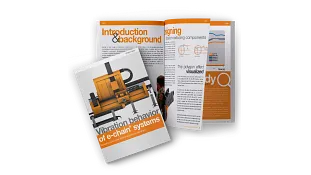
They can. Pin-and-bore link connections produce a stepping motion as the carrier rolls through its bend radius — the polygon effect — and that vibration travels into the support trough, the machine, and eventually the cut. It's also a solvable problem, and the most cost-effective place to solve it is in the component rather than in an add-on damping system. A short pitch length combined with a polymer spring link connection reduces it at the source. In an independent RWTH Aachen study of five carriers under highly dynamic motion, igus e-chain® systems averaged 28% lower vibration than the alternatives tested.
Common Applications


Frequently Asked Questions
Most machine tools require five electrical types — motor and VFD, servo, encoder or feedback, control, and data such as industrial Ethernet — often alongside hydraulic and pneumatic lines in the same package. The more useful question is which of those lines move. A cable sitting static in a cabinet has very different requirements from one flexing several million times over the life of the machine. Every line that travels with an axis needs continuous-flex construction, appropriate shielding, and a bend radius the carrier can accommodate. chainflex® cables are available across all five types, so the moving package can be specified as a set.
The environment decides. Open carriers work well in relatively clean conditions and offer easier filling, inspection, and heat dissipation. Enclosed carriers and tube systems are the right choice where chips, swarf, coolant spray, or abrasive dust are present, because they prevent debris from entering the carrier and abrading the cables inside. Machining, turning, and grinding operations usually justify an enclosed design. Hot swarf raises the requirement further, since chips landing on a standard carrier can stick and burn into the material — carrier materials are available that resist chips up to 850°C without burn-in.
Sizing follows the cable package, not the machine. Lay out every cable and hose that will travel, then work through inner height and width, the largest minimum bend radius in the package, total fill weight, and travel length. The bend radius is set by the least flexible cable in the bundle, so one oversized line can determine the entire carrier selection. Travel length then decides whether the application runs unsupported or gliding. Leave clearance around each cable rather than filling the cross section, and size for the package you expect to add later. An online configurator handles the calculation once these values are known.
Each cable should have its own defined space. Separators and shelves keep individual lines from twisting around one another, which is what causes the corkscrewing and abrasion behind most cable failures inside a carrier. Cables laid loosely in a shared cavity will migrate under motion, wear against each other, and eventually break. Arrangement matters too: keep power and motor cables away from encoder, control, and data lines, give hoses their own compartments since they change diameter under pressure, and distribute weight symmetrically across the carrier width. Contact wear between moving parts is a recurring problem throughout a machine tool, not only inside a carrier. See wear components for machine tools for the surfaces where sliding contact cannot be designed out.
Strain relief should be applied at the moving end of the energy chain at minimum, and ideally at both the moving and fixed ends for maximum protection. Download our white paper for an in-depth look at strain relief in cable carriers.
That is a calculable number rather than an estimate. Service life depends on bend radius, travel length, speed, acceleration, and cycle count, and every chainflex® cable is tested in the igus® laboratory across those variables before it reaches the catalog. An online service life calculator returns a predicted life for your specific configuration once you enter the application parameters, so you can compare options and plan replacement intervals before you order. Because that prediction rests on test data rather than modeling alone, chainflex cables carry a guarantee of up to 4 years.
Scheduled replacement based on calculated service life is the simplest approach and covers most machines, since a planned interval lets replacement happen during scheduled downtime rather than mid-production. Condition monitoring covers what that does not. smart plastics sensors measure the actual condition of the moving system rather than assuming a fixed interval, tracking forces in the carrier and electrical condition in the cable, and the i.Cee module turns that data into a predicted remaining service life that can trigger a maintenance notification or integrate with existing machine monitoring.
Most of the labor is not in the carrier — it is in pulling, cutting, terminating, separating, and strain-relieving dozens of cables by hand. Carriers that open along the radius let a technician fill the chain without tools, and pre-harnessed cables arrive cut to length and terminated. readychain® goes further, delivering the carrier, cables, hoses, connectors, and strain relief as a single pre-assembled, tested system that mounts directly to the machine. In one machine tool application, chain installation that previously took two employees roughly a week and a half per axis was completed for all four axes in half a day.
The number of directions the cable package travels in decides it. A standard e-chain® carrier is the right choice wherever motion follows a defined linear path. triflex® R 3D carriers move in multiple directions at once while limiting the bend radius and preventing uncontrolled twisting, which is why they suit multi-spindle lathes, endlessly pivoting cutting heads, tool-handling movements, and robots working alongside a machine. If your motion is linear, use a standard carrier; if it rotates or pivots while it travels, specify a 3D system. For rotation without linear travel, the answer is different again, and often a hollow-center bearing or a rotary carrier rather than a 3D system.
Contact Us
Questions or product information? Please contact:

Customer Service
Customer Service:
Phone: Monday to Friday from 8 am - 8 pm
LiveChat: 24 hours
Book a Call
Book an Appointment with a Product Expert